Build Performance
ReScript considers performance at install time, build time and run time as a serious feature; it's one of those things you don't notice until you realize it's missing.
Under the Hood
Since ReScript v12, rescript build uses a native build system written in Rust. It reads rescript.json, tracks dependencies between modules and packages, and invokes the compiler directly. See Reforging the ReScript Build System for more about its architecture.
The JS Wrapper
The rescript command is a thin Node.js wrapper around the native rescript.exe binary. Both building and watching are handled by the native binary.
The binary ships in a platform-specific package at node_modules/@rescript/{your-platform}/bin/rescript.exe, for example node_modules/@rescript/darwin-arm64/bin/rescript.exe on an Apple Silicon Mac. The wrapper selects the package for your platform and sets RESCRIPT_RUNTIME to the installed runtime package's path. Prefer rescript build and rescript watch so this setup is handled for you.
Legacy Build System
The pre-v12 build system remains available through rescript-legacy. It uses Ninja, a cross-platform, low-level build system. It reads rescript.json, generates Ninja build files in lib/bs, and runs Ninja to execute the compiler commands.
Profile Legacy Builds
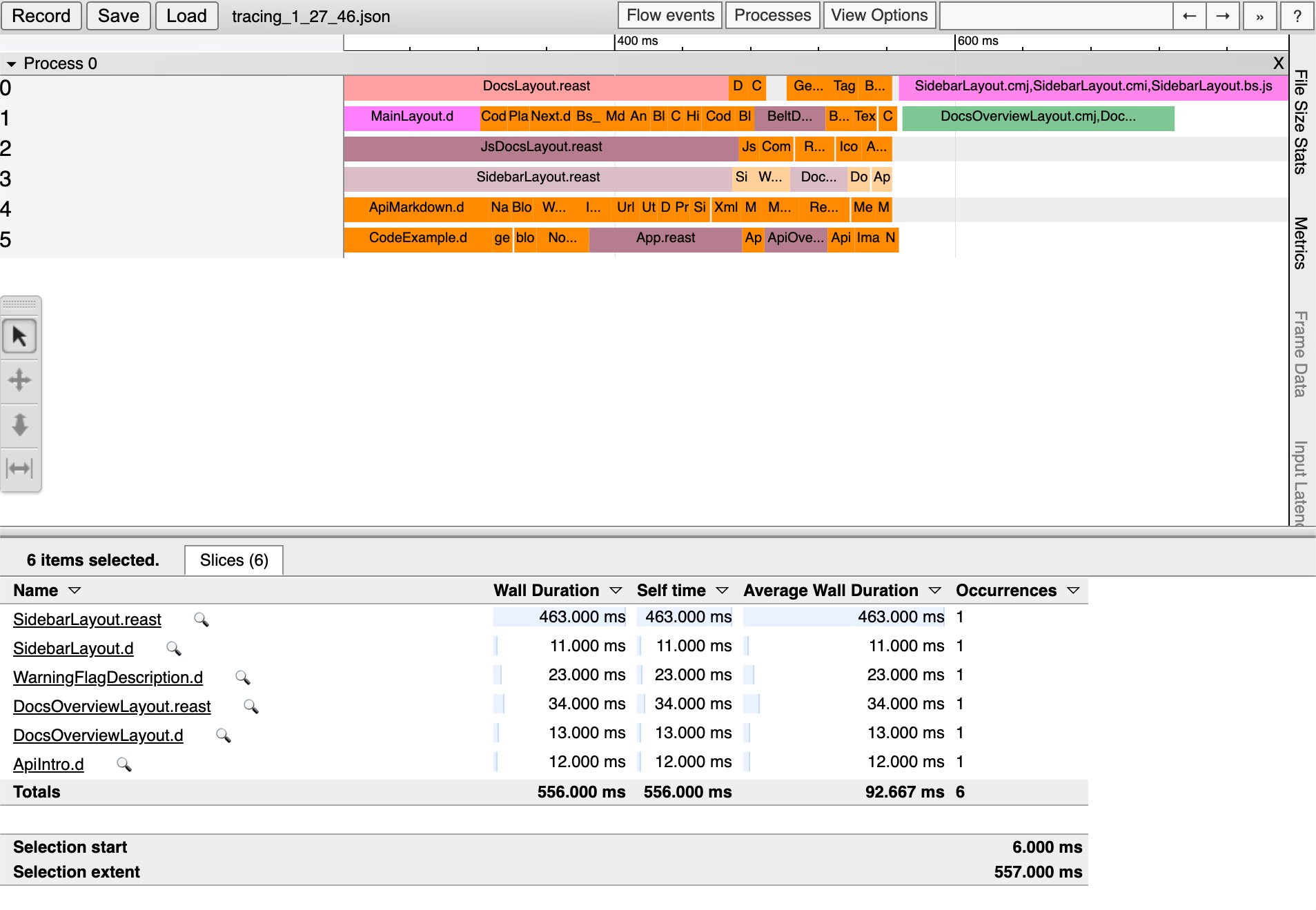
For builds made with rescript-legacy, bstracing turns Ninja's build log into a performance trace:
SH./node_modules/.bin/bstracing
Run the above command at your ReScript project's root; it'll spit out a JSON file you can drag and drop into chrome://tracing.
Historical Measurements
The following measurements were made with the pre-v12 Ninja-based build system. They are not benchmarks of the current build system.
A native build of a small project took around 70ms, compared with roughly twice that through the old JS wrapper. That wrapper also provided watch mode.
A no-op build (when no file changed) took around 15ms. An incremental rebuild of a single file took around 70ms too.
Extreme Test
We stress-tested the old native build system on a big project of 10,000 files (2 directories, 5000 files each, first 5000 no dependencies, last 5000 10 dependencies on files from the former directory) using https://github.com/rescript-lang/build-benchmark, on a Retina Macbook Pro Early 2015 (3.1 GHz Intel Core i7).
No-op build of 10k files:
800ms(the minimum amount of time required to check the mtimes of 10k files).Clean build: <3 minutes.
Incremental build: depends on the number of the dependents of the file. No dependent means
1s.
Incrementality & Correctness
ReScript doesn't take whole seconds to run every time. The bulk of the build performance comes from incremental build, aka re-building a previously built project when a few files changed.
In short, thanks to our compiler and the build system's architecture, we're able to only build what's needed. If MyFile.res isn't changed, it isn't recompiled. Renaming or moving files is handled automatically, with no stale builds.
Speed Up Incremental Build
ReScript uses the concept of interface files (.resi) (or, equivalently, module signatures). Exposing only what you need naturally speeds up incremental builds. E.g. if you change a .res file whose corresponding .resi file doesn't expose the changed part, then you've reduced the amount of dependent files you have to rebuild.
Programmatic Usage
Unfortunately, JS build systems are usually the bottleneck for building a JS project nowadays. Having parts of the build blazingly fast doesn't matter much if the rest of the build takes seconds or literally minutes. Here are a few suggestions:
Convert more files into ReScript =). Fewer files going through fewer parts of the JS pipeline helps a ton.
Careful with bringing in more dependencies: libraries, syntax transforms (e.g. the unofficially supported PPX), build step loaders, etc. The bulk of these dragging down the editing & building experience might out-weight the API benefits they provide.
Hot Reloading
Hot reloading refers to maintaining a dev server and listening to file changes in a way that allows the server to pipe some delta changes right into the currently running browser page. This provides a relatively fast iteration workflow while working in specific frameworks.
However, hot reloading is fragile by nature, and counts on the occasional inconsistencies (bad state, bad eval, etc.) and the heavy devserver setup/config being less of a hassle than the benefits it provides. We err on the side of caution and stability in general, and decided not to provide a built-in hot reloading yet. Note: you can still use the hot reloading facility provided by your JS build pipeline.